2nd WITCH
Second Workshop on Interdisciplinary Topics in Consequence and Hypothetical reasoning.
November 10th to 12th, 2025, from 1:30pm to 6pm.
Selvino Assmann room, CFH-UFSC, Florianópolis.
The Workshop on Interdisciplinary Topics in Consequence and Hypothetical reasoning aims to bring together researchers working on logic across a variety of disciplines. The workshop’s primary focus is the rigorous exploration of consequence and hypothetical reasoning from diverse perspectives.
Our central objective is to foster a collaborative and intellectually stimulating environment, one where participants can share ongoing work, engage in forward-looking discussions, and build meaningful connections. We hope to facilitate the discovery of synergies between different methodologies and viewpoints, encouraging innovative responses to the complex challenges posed by reasoning.
We are convinced that the cross-pollination of ideas among philosophy, mathematics, computer science, linguistics, and other fields will significantly deepen our understanding of logic and its wide-ranging applications.
| Program | November 10th | November 11th | November 12th |
| 1:30pm-2:30pm | Lauro Nunes Filho: A view on hypothesis: sequent calculus and the structure of inference | Larissa Gremelmaier Rosa: Studying Security Protocols: An Introduction with a Toy Protocol | Daniel Durante: Classical Logic and the Metaphysics of Presence |
| 2:30pm-3:30pm | Matheus Rui: Quantitative and qualitative approaches to doxastic reasoning | Jerusa Marchi: Como programar um computador quântico | Gustavo H. Damiani: An Epistemic Approach to the Hybrid Logic of Hide and Seek Game |
| 3:30pm-4pm | Coffee break | Coffee break | Coffee break |
| 4pm-5pm | Rodrigo Stefanes: Intuitionistic modal logic and model theory | Caio Silvano: Quantum teleportation and non-individuals: a way to maintain the identity of teleported classical objects | Evelyn Erickson: Underdetermination in logic: insights from value laden science |
| 5pm-6pm | Mariana Pase: The applications of mathematics according Newton da Costa | Raoni Arroyo & Jonas Arenhart: Emperor’s new individuality: non-individuals and the metaphysical nature of quantum objects | César Frederico dos Santos: Logic as technology |
Abstracts
- Lauro Nunes Filho: This presentation seeks to offer a perspective on the role of hypothesis within the sequent calculus, emphasizing how Gentzen’s framework describes the relation between assumption and consequence. By treating hypotheses as structural components of inference rather than mere premises, the discussion highlights the conceptual meaning of derivability and the dynamics of hypothetical reasoning across different logical systems.
- Matheus Rui: This talk aims to present and analyze attempts to connect two conceptions of rational doxastic states: the qualitative notion of “binary belief” (or simply belief) and the quantitative notion of “credence” (or subjective probability). This pursuit has been described as the search for a bridge principle. From a synchronic point of view, the goal is to identify a consistent and deductively closed principle that connects the Probability Theory with certain assumptions of Doxastic Logic. The main point of divergence concerns the diachronic aspect of the bridge, and more specifically, the correct principles to follow when revising a set of binary belief. In this regard, two major approaches compete for dominance: one based on AGM Theory, and another grounded in the Preferential Model Semantics of non-monotonic logic.
- Rodrigo Stefanes: Modal logic is a fragment of first-order logic that provide us a framework for dealing with state-based systems. Because of this, it inherits the classical basis of first-order logic. Several works have proposed formulations of a modal logic based on intuitionistic rather than classical principles. In his 1994 thesis, “Intuitionistic Modal Logic and Model Theory”, Simpson argues that the appropriate intuitionistic modal logic is IK, since it corresponds to the modal fragment of first-order intuitionistic logic. In this talk, I will introduce the basic concepts of IK and first-order intuitionistic logic, and then discuss some results concerning the characterization of the logic IK.
- Mariana Pase: The success of mathematics in the empirical sciences raises an important philosophical question: how can abstract entities so effectively describe the physical world? Eugene Wigner (1960) was one of the first to highlight this problem, considering the success of mathematics almost a miracle without a plausible explanation. Although he does not respond directly to Wigner, Newton da Costa (1980) offers a possible solution through his multivalent platonist conception, consistent with the scientific philosophy he had previously developed. Thus, this work will analyze the problem in light of da Costa’s realism and the two types of application he proposes, seeking to understand how he articulates the relationship between mathematics and physical reality.
- Larissa Gremelmaier Rosa: Security protocols are essential components of distributed systems, responsible for ensuring properties such as authentication, confidentiality, and integrity. The formal study of these protocols allows for the identification of vulnerabilities and the verification of desirable properties prior to implementation. This talk presents an introduction to the use of logical models for the analysis of security protocols in computing. Using a toy protocol as an example, we will discuss different modeling approaches (including methods based on multiset rewriting theory) and how each can represent distinct aspects of the agents’ behavior and knowledge. The goal is to provide an overview of formal techniques used in protocol verification and to illustrate how logic can be applied to reason about security in a rigorous and systematic way.
- Jerusa Marchi: Nesta palestra falarei sobre o cenário nacional de computação quântica, sobre o grupo de computação quântica da UFSC e sobre o desenvolvimento da plataforma Ket e seu impacto no cenário nacional.
- Caio Silvano: This paper explores the concept of classical object identity in the context of quantum teleportation, addressing the constraints imposed by the non-cloning theorem. Firstly, we define classical object identity: a classical object possesses identity due to its unique classical state (e.g., position, velocity, mass), which allows it to be distinguished from other classical objects or parts of itself. This identity is encoded in classical information. Secondly, we explain the process of quantum teleportation. This protocol enables the transfer of the classical information defining the state of one qubit (quantum bit) to another qubit, mediated by pre-shared entanglement and classical communication. The original qubit’s state collapses upon measurement, preventing its direct copying. The teleportation protocol relies on measuring the correlations between the original and auxiliary qubits within an entangled pair, then communicating the measurement results classically to the distant qubit, which is then manipulated to adopt the original state. The no-cloning theorem dictates that it is impossible to create an identical copy of an arbitrary unknown quantum state. This impossibility directly prevents the duplication of quantum information during teleportation. A proof sketch of the non-cloning theorem demonstrates that a hypothetical cloning machine, producing an identical output state for any input state |ψ⟩, cannot exist. Finally, we argue that the non-individuality inherent in quantum systems plays a crucial role in enabling the preservation of classical identity during teleportation, while respecting the non-cloning theorem. Since the original object’s classical identity is represented by the set of its properties (its state), and this state cannot be perfectly copied, teleportation does not violate the no-cloning theorem. Instead, the identity is transmitted via the classical information derived from measuring the correlations between the original state and the entangled auxiliary state. The original classical object ceases to exist in its initial state (due to measurement collapse), and the identity is reconstructed on the target (non-individual) qubit. This demonstrates how quantum processes can transmit classical identity despite the prohibition on cloning arbitrary quantum states.
- Raoni Arroyo & Jonas Arenhart: Deep scientific realism is scientific realism plus the claim that science requires a metaphysical interpretation. Metaphysics is supposed to fill an intelligibility gap: science by itself, it is argued, does not provide a clear image of reality. The metaphysics needed to deliver the goods comes from a toolbox of concepts furnished by free range metaphysics. Such concepts are developed in connection with a world that is familiar to us, and by being applied to science, they carry this familiarity to the most unfamiliar confines of reality. This article examines the prospects of such a strategy. Focusing on the case of quantum objects’ (non)individuality, it argues that deep realism fail to deliver the promised intelligibility. Construing quantum entities as non-individuals faces an empty toolbox, ‘non-individuality’ being too closely attached to quantum mechanics itself. Dressing quantum entities as individuals distorts the usual familiarity brought by the concept of individuality, since it now has to conform to the unusual demands of quantum mechanics to the point of being unrecognizable. Instead of enhancing our grasp of quantum reality, the imposition of metaphysical categories risks producing not understanding, but metaphysical misunderstanding.
- Daniel Durante: If I drink and drive, I break the law. But that doesn’t mean that if I drink, I break the law, or if I drive, I break the law. Or does it? This clash, where logic and common sense diverge, is not a mere puzzle. It exposes the profound connection of classical logic with the “metaphysics of presence,” which Heidegger so heavily criticized, and points to a surprising alternative path, born from within logic itself.
- Gustavo H. Damiani: This talk proposes an epistemic approach to H(LHS), the hybrid logic of the hide-and-seek game. The original Logic of Hide and Seek (LHS), inspired by modal graph games and logic design, was later hybridized. The game features two players, a Hider and a Seeker, moving in alternate turns to successor positions on a graph. The Seeker aims to occupy the Hider’s position, while the Hider seeks to avoid capture. LHS defines player movement using two distinct modalities, as well as a constant I to denote when players are in the same location. While the semantics is the standard Kripke models, formulas are evaluated at two states. The introduction of the basic hybrid language (nominals and a satisfaction operator) is sufficient for players to name and refer to specific states. This presentation focuses on adding epistemic operators to H(LHS), allowing players to reason within the game about the other’s location and thus make more strategic moves toward winning.
- Evelyn Erickson: Treating logical theories akin to scientific theories regarding revision has twice begged the question: first in selecting data and second in finding a mechanism with which to choose the best theory. This has happened due to the standpoint that both these aspects of theory choice should be neutral, and none could be found. If there is nothing neutral to find, then the discussion can be enriched by talking about how logical theories are laden. From this standpoint, logical evidence cannot be separated from the broader context in which our logical practices occur. The current talk will stretch the analogy of logic with science into the realm of value ladenness. If one accepts that logic is continuous with science, then one must be mindful of the language, methods, and values of our logical theories.
- César Frederico dos Santos: Anti-exceptionalists about logic claim that logic is continuous with science. Yet this view contrasts with what logicians actually do: they neither collect nor analyze empirical data, and it is far from clear what kind of phenomena logic is supposed to describe. In this talk, I propose that logic is better understood as a technology rather than a science. Logicians resemble engineers more than scientists: they invent new artifacts (symbolic tools) to overcome specific difficulties. Historically, logic aimed to overcome cognitive limitations—such as belief bias—to support sound deductive reasoning. Today, logicians develop tools for a wide range of purposes, including information processing, artificial intelligence, the clarification of philosophical problems, and conceptual engineering. I elaborate on this technological conception of logic and its implications for how we understand truth in logic and the distinction between pure and applied logic.
Organizers
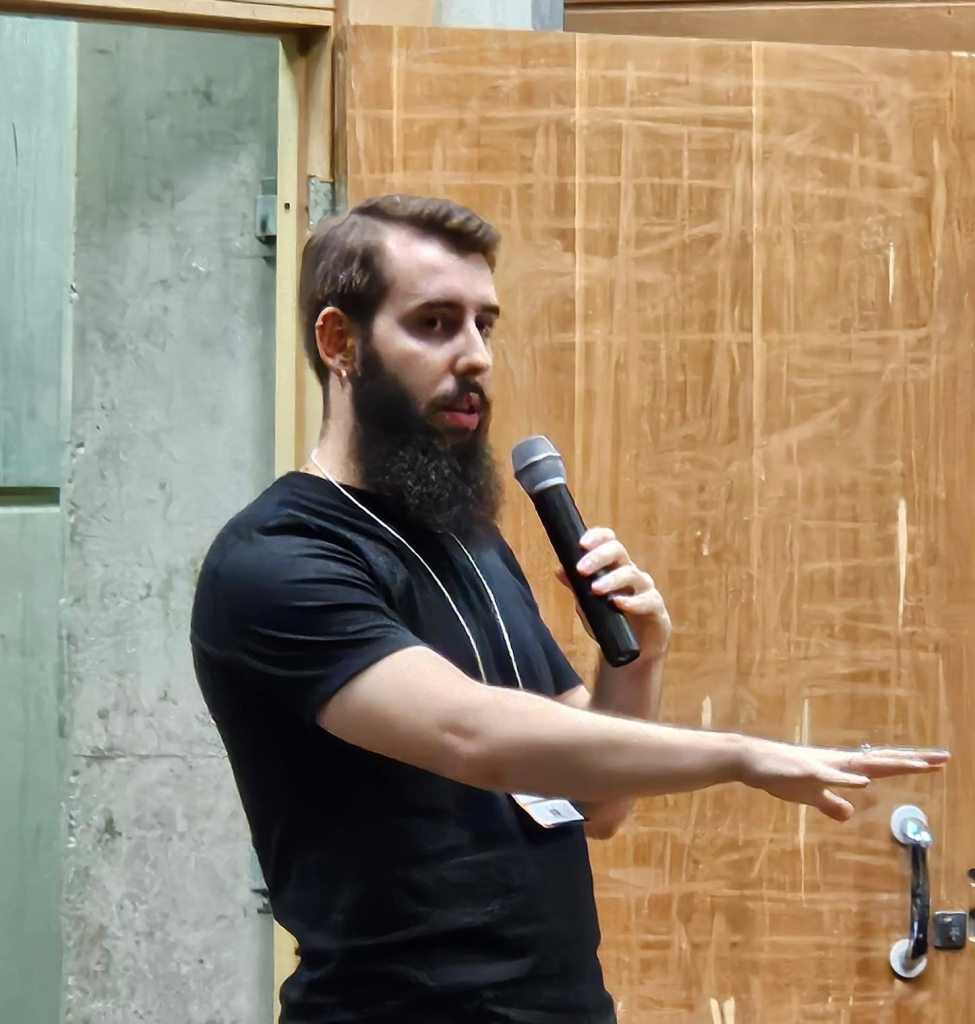
Gustavo H. Damiani
PhD Candidate at the Graduate Program in Philosophy at UFSC.
FAPESC Scholarship holder.

Rodrigo Stefanes
Undergraduate student in Mathematics at UFSC.
E-mail: <witch.organizers@gmail.com>
1st WITCH: <https://logicandlinguistics.ufsc.br/wp/witch-2025/>