

The Workshop on Interdisciplinary Topics in Consequence and Hypothetical reasoning aims to bring together researchers working on logic across a variety of disciplines. The workshop’s primary focus is the rigorous exploration of consequence and hypothetical reasoning from diverse perspectives.
Our central objective is to foster a collaborative and intellectually stimulating environment, one where participants can share ongoing work, engage in forward-looking discussions, and build meaningful connections. We hope to facilitate the discovery of synergies between different methodologies and viewpoints, encouraging innovative responses to the complex challenges posed by reasoning.
We are convinced that the cross-pollination of ideas among philosophy, mathematics, computer science, linguistics, and other fields will significantly deepen our understanding of logic and its wide-ranging applications.
Schedule
| Tutorial | May 11th Selvino Assmann room, CFH-UFSC | May 12th Selvino Assmann room, CFH-UFSC | May 13th Selvino Assmann room, CFH-UFSC |
| 9am-11am | Cezar A. Mortari: História da Lógica | Cezar A. Mortari: História da Lógica | Cezar A. Mortari: História da Lógica |
| General program | May 11th Selvino Assmann room, CFH-UFSC | May 12th Selvino Assmann room, CFH-UFSC | May 13th Selvino Assmann room, CFH-UFSC | May 14th Selvino Assmann room, CFH-UFSC |
| 1:30pm-2:30pm | Jonas Arenhart: Rescuing logical instrumentalism | Silke Körber, Evelyn Erickson & Ivan da Cunha: Workshop: A discussion of Susan Stebbing’s ‘Logical Positivism and Analysis’ | Silke Körber*: Scientific Utopianism and Humanism: Engineering Postwar Democracies | Martín Barra-Acuña: Mechanisms for Scientific Institutions: Some Thoughts on the Use of Mechanism Design in Philosophy of Science |
| 2:30pm-3:30pm | Robert Lima: Free Logics of Formal Inconsistency | Silke Körber, Evelyn Erickson & Ivan da Cunha: Workshop: A discussion of Susan Stebbing’s ‘Logical Positivism and Analysis’ | Silke Körber*: Scientific Utopianism and Humanism: Engineering Postwar Democracies | Thaís Bardini: Combinatorial Group Testing: from Pandemic Screening to Cryptography |
| 3:30pm-4pm | Coffee break | Coffee break | Coffee break | Coffee break |
| 4pm-5pm | Emily Ovalhe: Paraconsistency, Evidence and Truth | Silke Körber, Evelyn Erickson & Ivan da Cunha: Workshop: A discussion of Susan Stebbing’s ‘Logical Positivism and Analysis’ | Mariana Pordeus: The historical narratives of Van Fraassen’s ‘The Tower and the Shadow’ | Caio Silvano: Metaphysically Explicit Physics: obtaining Quantum Probabilities through Quasi-Set Theory and a Non-Individuals Interpretation of Quantum Mechanics |
| 5pm-6pm | Mikael Bombassaro: The Profound Influence of McTaggart’s Time Series on Tense Logic | Silke Körber, Evelyn Erickson & Ivan da Cunha: Workshop: A discussion of Susan Stebbing’s ‘Logical Positivism and Analysis’ | Evelyn Erickson: Teaching profiles for logic: a sketch | Ivan Pontual: From classical to quantum probability and back |
Abstracts
- Cezar Mortari: Este minicurso faz uma breve introdução à lógica antiga e medieval. Falaremos sobre a lógica de Aristóteles, sobre as escolas megárica e estoica, e sobre alguns tópicos de lógica medieval, como consequências e insolúveis.
Os slides estão disponíveis em <https://drive.google.com/drive/folders/11FUk8j0vsYWg6IJg6IPp_lcDbRVcra4O?usp=sharing>.
- Jonas Arenhart: According to logical instrumentalism, there is no logical consequence in natural language; as a result, no logical theory can be correct, in the sense of correctly describing validity as an extra-theoretical notion. Two common arguments against such a view indicate that a) logical instrumentalism reduces itself to an uninteresting and uncontroversial view of logic as a mere tool, and that b) the view lacks resources to explain why applications of logic are successful. We present formulations of the claims and argue that they are not effective against logical instrumentalism.
- Robert Lima: Free logics are variations of classical first-order logic in which singular terms do not need to be interpreted as individuals in the domain of quantification. Under an orthodox interpretation of quantifiers, free logics are those in which singular terms do not need to denote existents. On the other hand, logics of formal inconsistency (LFIs) are paraconsistent logics that can express explicit assumptions about the consistency of their formulas. By doing so, these logics can restrictively recapture the principle of explosion. This talk aims to outline the basis and motivations for combining these two kinds of logics.
- Emily Ovalhe: Classical logic is usually understood as a model of logical consequence in natural language. However, there are valid inferences in classical logic that lack intuitive justification (in particular, the principle of explosion), and there are inferences in natural language that seem intuitively valid but cannot be formalized within classical logic (in particular, semantic paradoxes). In light of these limitations, at least two positions seem to emerge: (i) to preserve classical logic as a model of logical consequence in natural language, accepting that certain aspects of natural language must be abstracted or revised, at the cost of our intuitions about the notions of truth and validity; (ii) to preserve these intuitions and reject classical logic as a model of logical consequence in natural language, adopting instead a non-explosive logic. Graham Priest, a proponent of dialetheism, according to which there are some true contradictions, adopts the second position. In this talk, I intend to present and analyze his arguments for this view, clarifying his criteria for adopting the Logic of Paradox as the one true logic for modeling reasoning in natural language.
- Mikael Bombassaro: This presentation aims to develop the first chapter of Prior’s Past, Present and Future (1967), in which he outlines the influence of McTaggart’s proof of the unreality of time on the development of Tense Logic. Indeed, while this influence is widely acknowledged, I contend it has not been justly valued. To address this, I intend to show how Tense Logic grounds its semantics in specific passages of The Unreality of Time (1908) and the second volume of The Nature of Existence (1927). This is achieved by adopting the McTaggart’s Time Series as the foundation for any instant-based structure 𝔗, where their basic laws are established as the elementary rules for temporal operations. Thus, addressing this topic of History of Logic, I intend to show that the influence of McTaggart’s Time Series on the development of Tense Logic is far deeper than what Prior himself recorded — but not only that, for, more importantly, it should be noted that, starting from the reading of McTaggart, we notice how these conceptions, which are the very semantics of Tense Logic, are for the most part rooted in common sense and in our reasonable understanding about temporality.
- Silke Körber, Evelyn Erickson & Ivan da Cunha: This workshop presents an overview of Logical Empiricism and of Susan Stebbing’s thought, followed by a discussion of the text “Logical Positivism and Analysis” (1933), recently translated by Evelyn Erickson to Portuguese as “Positivismo Lógico e Análise” <https://doi.org/10.21680/1983-2109.2026v33n70ID41776>. The original text, in English, can be found here: <https://drive.google.com/file/d/1d3DV3VYD8_vWvkIkXxwxN0SB1FwdDrqi/view?usp=sharing>. For further reading: <https://drive.google.com/file/d/1wxX20kr35eNqJ3rVvakazz1-Tl5pp68x/view?usp=sharing>.
- Silke Körber*: Amid the crises of the early twentieth century, leftist and liberal thinkers—including George Sarton, Otto Neurath, L. Susan Stebbing, Julian Huxley, Joseph Needham, and John Dewey—advanced a modern scientific outlook grounded in rational inquiry as a defense against totalitarianism. This paper examines their intellectual exchanges in the 1930s and 1940s, arguing that their commitment to logic, public education, and scientific utopian thinking formed a strategic response to democratic crisis. Their visions of a “new humanism” also contributed to the founding of UNESCO under Julian Huxley, promoting science as a collective tool for postwar reconstruction. Although partly curtailed by the Cold War, these ideas remain relevant, raising enduring questions about the responsible use of scientific knowledge.
- Mariana Pordeus: In one of the chapters of “The Scientific Image”, Van Fraassen recounts a short story about a traveler who visits the home of an old family friend. There, the man is puzzled as to why a tall tower was constructed in such a position that its shadow would turn the terrace in which they would take their afternoon tea cold and dark. The protagonist is then offered two distinct explanations for the tower’s shadows. Through Van Fraassen’s theory of explanation, we are able to analyze those two accounts as answers to why-questions. In this presentation, I argue that these explanations can be understood as narrative accounts — tools commonly found in historiographical work. By applying Hayden White’s narrativist philosophy of history, we are able to examine the literary character of these narratives without compromising their explanatory power, thereby providing multiple comprehensive and useful answers to why-questions regarding the past.
- Evelyn Erickson: The teaching of logic is a topic usually approached by the field of mathematical pedagogy or by the literature on critical thinking and philosophical education. This presentation proposes to deal with the topic of teaching logic from the perspective of the epistemology of logic, guided by some metaphilosophical considerations. The aim is to discuss who benefits from logical training, and what students should learn. The aim is to bring together both historical, cognitive and methodological considerations into thinking about the role of logic in philosophy, based on the view of logic as a cognitive tool. There is currently a certain status quo in Logic syllabus: classical propositional logic and first-order logic should be taught. While some students learn this easily, most struggle. Seeking to broaden the vision of what it means to teach logic, we have defined the following profiles: (1) logic as a philosophical instrument (following the so-called analytical tradition), (2) logic for expert argumentation (public argumentative competence), (3) logic as a scientific methodology (mapped into “deduction”, from the Peircean scheme of deduction/induction/abduction), and (4) logic for citizens (logic as critical thinking). What objectives, content, and methods are appropriate for each profile? We will articulate these different profiles around the axes of competence in reasoning in natural vs. formal languages, different deductive systems that can be taught, and the philosophical view of logic that underpins with each endeavor, as well as consider the balance between the difficulty of learning certain skills and the cognitive gain of mastering specific heuristics for solving exercises.The teaching of logic is a topic usually approached by the field of mathematical pedagogy or by the literature on critical thinking and philosophical education. We propose to deal with the topic of teaching logic from the perspective of the epistemology of logic, guided by some metaphilosophical considerations.
- Martín Barra-Acuña: This presentation argues that while game-theoretic models in philosophy of science have significantly advanced our understanding of the epistemic dynamics of scientific communities—shedding light on aspects such as cooperation, theory choice, and the persistence of pluralism—they remain largely descriptive. What is missing is a framework for evaluating and designing the institutional structures that shape these dynamics. I suggest that mechanism design theory can help fill this gap. By modeling how incentive structures and decision rules affect epistemic and social outcomes, mechanism design enables a more rigorous hypothetical reasoning about scientific communities. As a preliminary sketch of its possible uses, this approach shows how mechanism design can enrich debates in the political philosophy of science by clarifying which institutional configurations are more likely to promote social epistemic goals.
- Thaís Bardini: How can we identify a few “positive” cases within a massive population without testing everyone individually? This talk introduces Combinatorial Group Testing, a mathematical approach that uses combinatorics to save time and resources. By strategically pooling samples together, we can use a single test result to exclude large groups of “negative” individuals, narrowing down the search for “positives” with minimal effort. We will explore how this strategy became an important tool for large-scale screening during pandemics and how the same framework can be applied to solve problems in cryptography. The focus will be on how simple mathematical structures can solve urgent, real-world challenges.
- Caio Silvano: In Quasi-Set Theory (Q), the concept of a set is extended and becomes that of a quasi-set, which is defined as neither of two types of atoms: neither M-atoms (that represent classical objects) nor m-atoms (that represent objects of quantum mechanics (QM)). An important concept is that of weak extensionality (KRAUSE; ARENHART, 2015), which implies that if two or more quasi-sets have the same quasi-cardinality and are composed of the same number of m-atoms of the same type, they are also indiscernible from one another. This situation appears to adequately describe what occurs in physical systems, since atoms of the same element must function identically. Nevertheless, we can distinguish between atoms of different elements, even if each ‘species’ of component (protons, neutrons, electrons, quarks, gluons, etc.) comprises several indiscernible particles. This assists us in providing an adequate semantics for logic and in achieving a more intelligible metaphysical interpretation as well. We observe that this conclusion aligns with the exposition in Da Costa et al. (2012) when evaluating their endeavours to develop non-reflexive systems. The authors reiterate that the idea underlying this theory is to be able to express, in some manner, collections (quasi-sets) of indiscernible objects without resorting to the concept of identity, since identity is not applicable to such entities. Thus, even if a type of cardinality (quasi-cardinality) has been defined, there can be no corresponding ordinal. The elements of these quasi-sets cannot be ordered or named, as that would render them identifiable. This would be consistent with the formalism of QM tied to the Copenhagen interpretation, which is the most widely adopted by physicists. One of the problems of dealing with indiscernible objects in QM grounded in standard mathematics (which is itself based on ZFC and First-Order Predicate Logic with Identity) is the forced introduction of such entities into the theory. Since, in principle, all elements of the adopted set theory possess identity, it becomes necessary to “appeal” to the Indistinguishability Postulate. With a more appropriate underlying theory, we could derive, for example, quantum statistics without recourse to this device. This is precisely what we shall do by employing Q and following the works of French and Krause (2006); Krause, Sant’Anna and Volkov (1999), and Santos (2000). We are interested in the occupation probability of each quantum state. To this end, we wish to determine in how many Ii modes ν fermions or bosons can be distributed across k states s. Each of the ways of composing the total energy value E of the system is called a microstate, and we seek here the configuration with the highest probability of occurrence (under a frequentist interpretation of statistics) given an energy value. We will find that the expressions obtained are the same as those found using the usual procedure, therefore concluding that, indeed, Quasi-Set Theory has the potential to allow the derivation of descriptions of quantum mechanical phenomena without the “appeal” to the Indistinguishability Postulate.
- Ivan Pontual: Classical probability, as described mathematically via Kolmogorov’s axioms, has been long accepted as the most suitable basis of nearly every technical account of uncertainty in the natural sciences, computer science and statistics. When applied to physics, however, classical probability seems to incorporate certain inbuilt realist biases which might be inadequate in describing the notorious added layers of uncertainty arising in quantum mechanics. In this talk, I shall argue that making sense of the latter indeed requires a deep revision of classical probability theory as applied to physics, and show how that seems to present some added, formidable challenges to any realist view about quantum objects.
Organizers
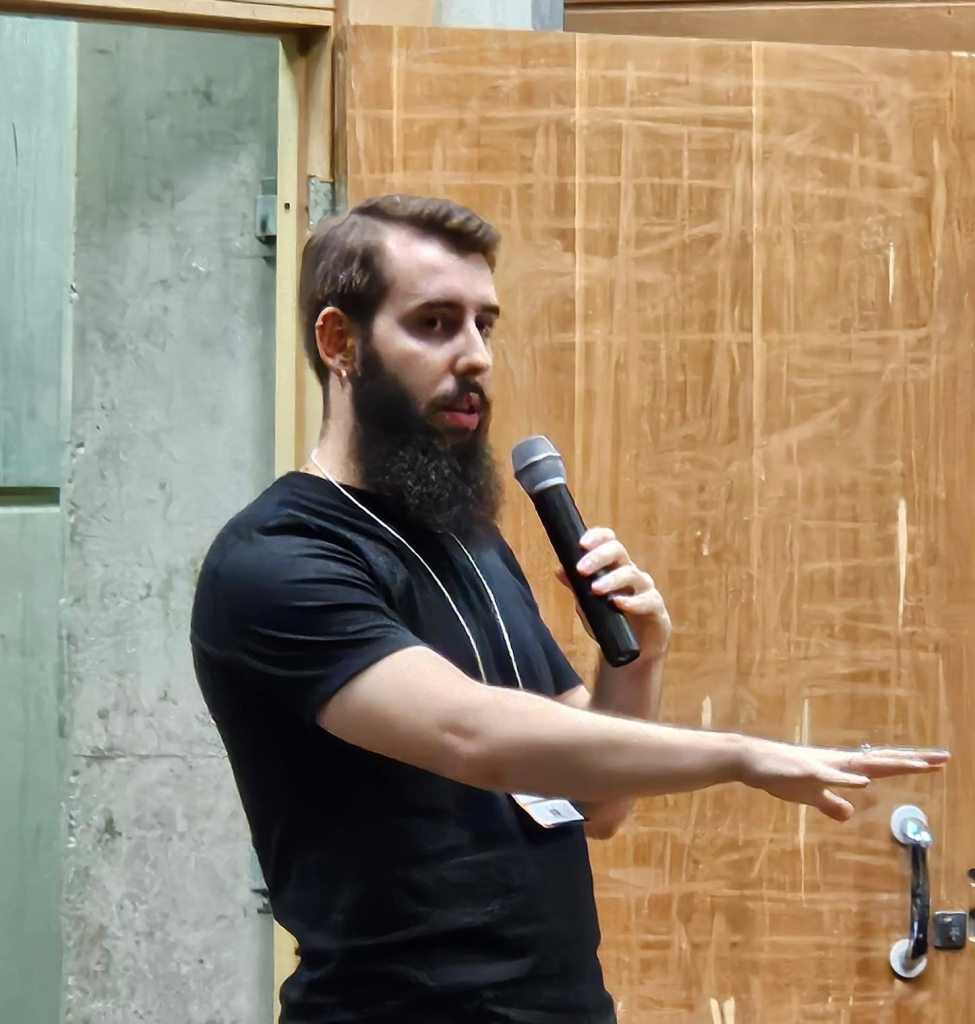
Gustavo H. Damiani
PhD Candidate at the Graduate Program in Philosophy at UFSC.
FAPESC Scholarship holder.

Rodrigo Stefanes
Undergraduate student in Mathematics at UFSC.

Mariana Pordeus
Undergraduate student in Philosophy at UFSC.
E-mail: <witch.organizers@gmail.com>
1st WITCH: <https://logicandlinguistics.ufsc.br/wp/witch-2025/>
2nd WITCH: <https://logicandlinguistics.ufsc.br/wp/witch2-2025/>